"It Learns Your Business" Is You, Typing
The pitch says the AI absorbs how you work. The reality is a person types every rule in by hand. Usually you.
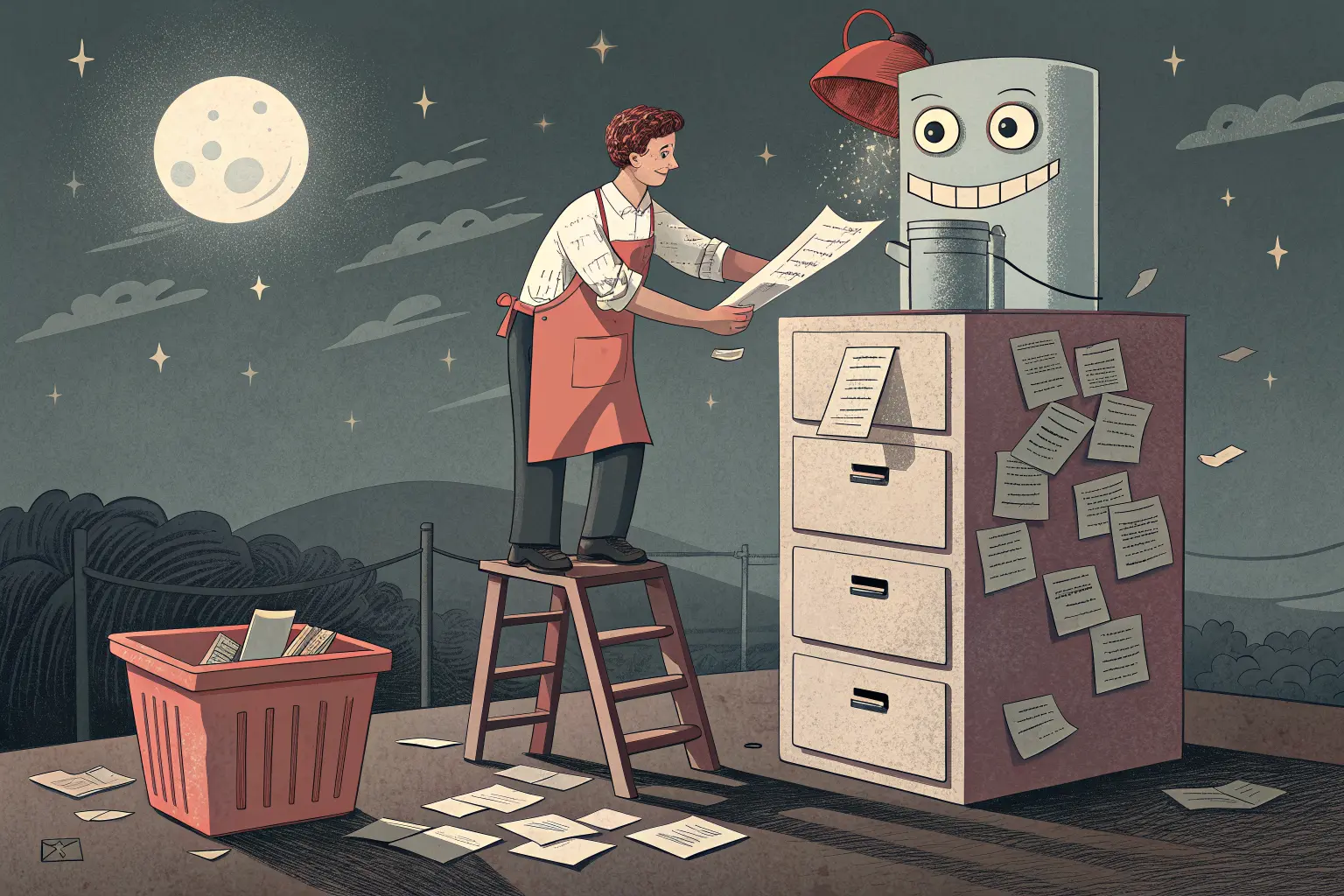
Every AI vendor selling to a small business eventually says the magic sentence. "It learns your business." It's on the landing page, it's in the demo, it's the line the rep reaches for the moment you ask a hard question. And it's one of the quietly dishonest things being sold right now, because there is no "it," and there is no "learning." There is a person with a keyboard, and most of the time that person is going to be you.
Let me tell you what actually happens, because I build this stuff for a living.
A while back I built a quoting system for a service business. The kind of thing a vendor would demo and say, "watch, it learns your pricing." Here is what learning looked like in practice. I sat down with a spreadsheet and typed in every price tier. Then every surcharge. Then the zip codes they don't service. Then the rule about bigger properties costing more, and then the exception to that rule for repeat customers, and then the other exception, the one the owner only remembered three weeks in because it lived in his head and nowhere else.
The model didn't learn a word of it. A human wrote it all down, one rule at a time, and the software executed instructions a person spent hours entering. That's not learning. That's data entry with a better marketing department.
The AI knows nothing about your business until a human tells it everything, in writing, on the record.
This matters because of who ends up doing the typing. When a vendor says "it learns your business," they mean one of two things, and neither is the thing you heard. Either you do the configuration, at night, after the demo glow wore off, for the privilege of the software you already bought. Or they do it, and it's billable, and the setup fee that stayed vague on the call gets very specific on the invoice.
The demo hides this on purpose. The demo runs on demo data. Clean, complete, pre-loaded, tuned so the tool looks like it read your mind. Your business is not demo data. Your business is fifteen years of undocumented exceptions, a pricing logic nobody ever wrote down, and a dozen "oh, except when" rules that live in one person's memory. None of that transfers by magic. Somebody has to drag it out into the light and type it in, and that somebody is measured in hours, not in a monthly fee.
Here's the part that should make you angry. "It learns your business" is engineered to make configuration sound automatic so nobody has to quote you the setup cost. The recurring price is on the page in bold. The forty hours of a human sitting there teaching the thing how you actually operate is nowhere. That's not an accident. Setup is exactly where these projects die, and a vendor who told you the truth about it would close fewer deals.
It gets worse the day something changes. Your business isn't a fixed document. You raise prices. You add a service. You drop a supplier and half your rules shift. Every one of those is a person going back into the configuration and re-teaching the machine by hand, again. "It learns your business" implies the thing keeps up with you on its own. It doesn't. It knows exactly what it was last told, frozen at that moment, until someone changes it. The week your prices go up and nobody updates the bot, it starts quoting last year's numbers with total confidence, to real customers, and it feels no shame about it.
Now, the fair objection. Isn't there real machine learning under some of these tools? Sometimes, yes, in the sense that a model was trained on the general internet long before it ever met you. But that training is about the world at large. It is not about you. It has never heard of your company. The gap between "this model can write English" and "this model knows you charge more for two-story houses" is the entire job, and that gap gets closed by a person, not by the software waking up one morning and understanding you.
So here is the thing to do, and it's one question, and it will tell you almost everything you need to know before you sign.
When a vendor says "it learns your business," ask them: who does the configuration, how many hours does it take, and what happens when one of my rules changes? Then make them answer in writing. Get the setup hours in the contract, not the pitch. If the answer is "oh, it's automatic," you've found either a liar or someone who has never once watched this get installed. If the answer is "our team handles it, that's the setup fee," good, now you know the real price. And if the answer is "you'll load that in yourself," understand that you just agreed to a second unpaid job, and price the software like the job it actually is.
The honest version of the sentence is short. It does what you teach it, teaching it is work, the work is real, and someone is going to do it. Any vendor who won't say that plainly is just hoping you don't ask who.