The Mechanical Turk Never Left
We keep selling human labor as artificial intelligence. The humans just moved further away and got paid less.
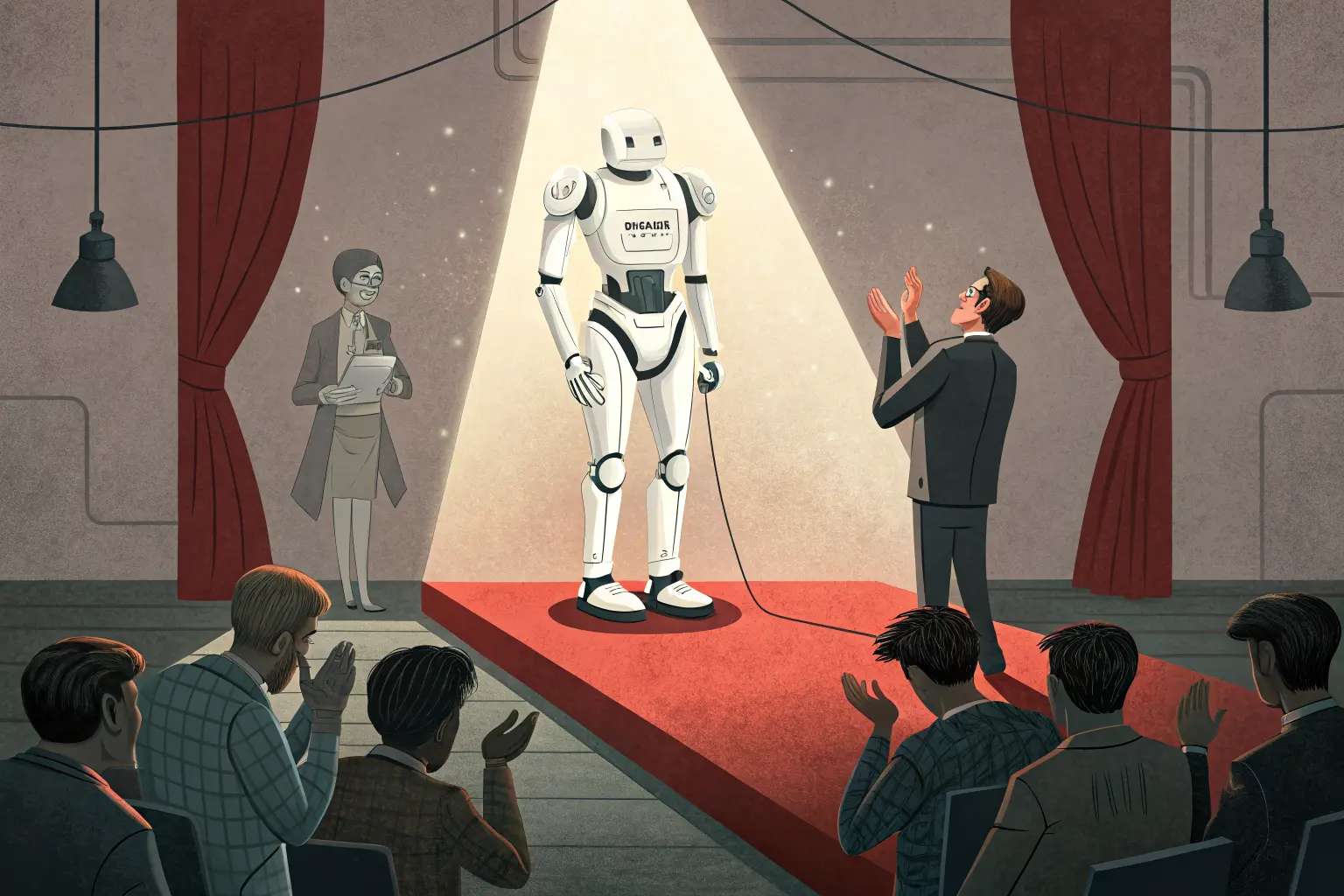
In 1770 a Hungarian inventor named Wolfgang von Kempelen rolled out a machine that could play chess. A carved wooden Turk in a turban sat behind a cabinet, moved the pieces with a mechanical arm, and beat almost everyone it faced, including Napoleon and Benjamin Franklin. It toured Europe and America for decades as a miracle of automation. It was a fraud. A human chess master was folded into the cabinet on a sliding seat, reading the board through magnets, making every move by hand. The marvel of the age was a guy in a box.
We never stopped building that box. We just moved the guy to Nairobi and stopped letting him take a bow.
Amazon, to its credit, named the trick out loud. Its crowdwork marketplace is literally called Amazon Mechanical Turk, a place where you pay real people pennies to do the "artificial intelligence" a computer can't. That was 2005. The honesty didn't last. Somewhere in the last decade the industry figured out that if you keep the humans off the org chart and off the stage, you can call the whole thing intelligence and charge a premium for it.
Here is the part the keynote skips. In January 2023, TIME reported that OpenAI used a firm called Sama to have Kenyan workers label reams of violent and sexual text so the ChatGPT filter would know what to block. The pay landed somewhere around two dollars an hour. People sat and read descriptions of the worst things humans do to each other, all day, so that your chatbot could feel clean and safe. The safety you experience as a smooth product is somebody else's trauma, outsourced and NDA'd.
The intelligence was never artificial. A lot of it was just offshore.
It goes way past content filters. Amazon spent years selling "Just Walk Out," the grab-your-groceries-and-leave stores where computer vision supposedly tracked what you took. In 2024 it came out that a large chunk of the magic was roughly a thousand workers in India reviewing and annotating the video of your shopping trip. The store wasn't watching you with a brain. It was watching you with people, on a delay, in another hemisphere. Amazon started winding the thing down not long after.
Then there's the labeling industry itself, which is the beating heart of this whole economy and almost never gets mentioned in the same breath as the models it feeds. Scale AI got to a fourteen-billion-dollar valuation, and in June 2025 Meta paid something like fourteen billion for a stake and hoovered up its founder. What does Scale actually do? It runs armies of humans in the Philippines, Kenya, and Venezuela who tag images, rank answers, and write the "correct" responses that models learn to imitate. The frontier lab is the visible tip. The thing holding it up is a spreadsheet of piecework wages you'll never see in a launch video.
None of this is a scandal because a machine got help. Every technology gets help. It's a scandal because of the story wrapped around it. We are told this is autonomous intelligence, a break from human labor, the thing that makes workers optional. Meanwhile the product only functions because a hidden global underclass is doing the parts the model can't, for wages that would be illegal in the country where the demo gets applauded. The automation narrative isn't describing a world without workers. It's describing a world where the workers are too far away and too cheap to count.
That distance is the entire trick, and it's a moral one, not a technical one. The original Turk hid one man behind a curtain a few feet from the crowd. The modern version hides tens of thousands behind a curtain made of subcontractors, time zones, and the word "platform." The closer a company gets to admitting how much human hands touch the output, the less magical, and the less valuable, the whole thing looks. So they don't admit it. The margins depend on you believing the box is empty.
I'm not saying the models are fake. They're real, they're useful, I use them every day. What's fake is the pretending. The honest version of the pitch is that we built an incredible interface on top of a supply chain of underpaid people, and we'd rather you not think about the second half. The Turk got exposed eventually. Someone opened the cabinet and found the man. That's still the only interesting question to ask about any AI product waved in your face. Who is folded into the box, and what are you paying them?
Open the cabinet. There's always somebody in there.