Your Company's AI Is a Pilot That Never Lands
Ninety-five percent of corporate AI pilots return nothing. That's not a failure rate. That's the business model.
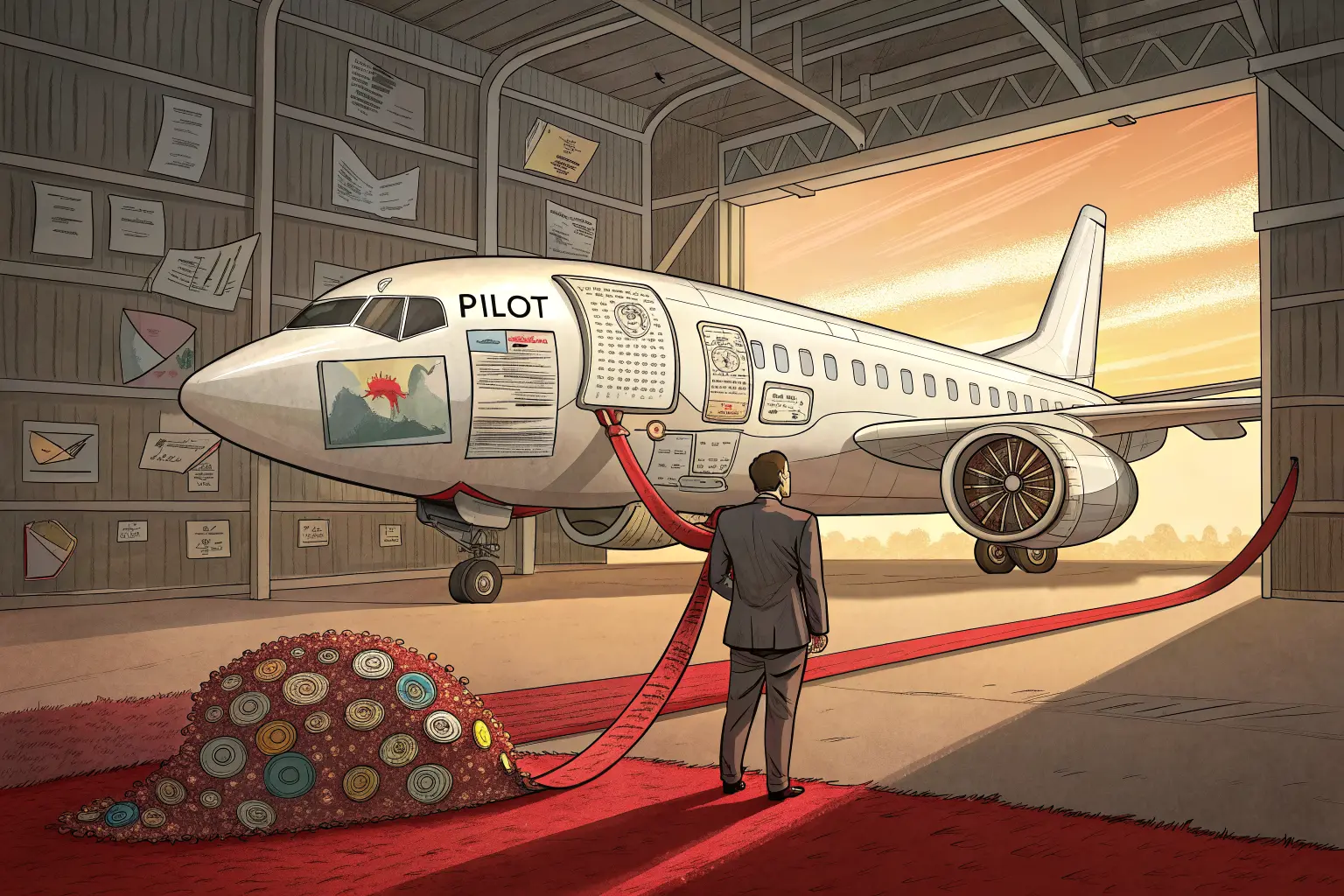
In August 2025, MIT put out a report that should have detonated a few boardrooms. They looked at enterprise generative AI and found that 95 percent of the pilots delivered no measurable impact on the bottom line. Not a small return. Zero. Companies had poured somewhere north of $30 billion into these projects, and nineteen out of twenty came back with a slide deck and a shrug. Everybody read it, nodded, and kept funding pilots. That reaction is the whole story.
Here is the thing nobody says out loud. The pilot that never ships is not a bug in corporate AI adoption. For a lot of companies, it is the entire point. A pilot is the safest possible position an executive can occupy. You get to stand on stage at the all-hands and say the company is "leaning into AI." You get the press release, the LinkedIn post, the analyst goodwill. And you never once have to bet your name on a system that might embarrass you in front of a real customer.
Shipping is where careers go to die. Shipping means the chatbot tells a customer something wrong and it ends up in a screenshot. Shipping means someone measures whether the thing actually saved money, and the answer is often no. A pilot has none of that downside. It lives in a sandbox, gets demoed to other executives, and quietly renews its budget every quarter. The perpetual pilot is a costume that lets a cautious company cosplay as an innovative one.
A pilot is the only project that can run for three years and never be wrong.
And an entire industry feeds on it. Consultants love a pilot because a pilot is billable forever and accountable never. There is no production system to maintain, no SLA to miss, just an endless runway of "phase two" workshops. The cloud vendors love it because every abandoned experiment still burns compute on the way to nowhere. The internal team loves it because "we're still iterating" is a much warmer place to live than "it launched and it flopped." Everyone at the table is incentivized to keep the plane in the hangar.
Look closer at that MIT number and it gets sharper. The 5 percent that worked mostly had one thing in common. They picked a narrow, boring problem, wired the tool into an actual workflow, and let it touch real data with real stakes. The failures did the opposite. They chased the flashy general-purpose assistant, the "AI transformation," the demo that wows a VP and helps no one. The gap between the two was not model quality. Everyone had access to the same models. The gap was whether anybody was willing to let the thing land and be judged.
This is the uncomfortable mirror. We keep blaming the technology for the disappointing returns, and the technology is not the problem. The models are genuinely good and getting better. The problem is that most organizations are structured to reward the appearance of progress over the risk of a real result. A pilot is appearance with the risk surgically removed. Of course they multiply. You built a machine that rewards them.
If you are running one of these, here is the only question that matters. What would it take to kill this pilot or ship it by the end of the quarter? If the honest answer is that nobody actually wants either, that nobody wants the accountability of a launch or the embarrassment of a cancellation, then you do not have an AI project. You have a very expensive way of looking busy, and the vendor invoicing you knows it better than you do.
The real AI story of this decade is not the models. It is the fleet of grounded planes, gleaming and demo-ready, that were never built to take off. Land the plane or scrap it. Anything in between is theater with a compute bill.