The Robot Is a Room Full of People
The word "automated" is doing a lot of lifting. Pull the curtain and it's a labeler in Nairobi making two dollars an hour.
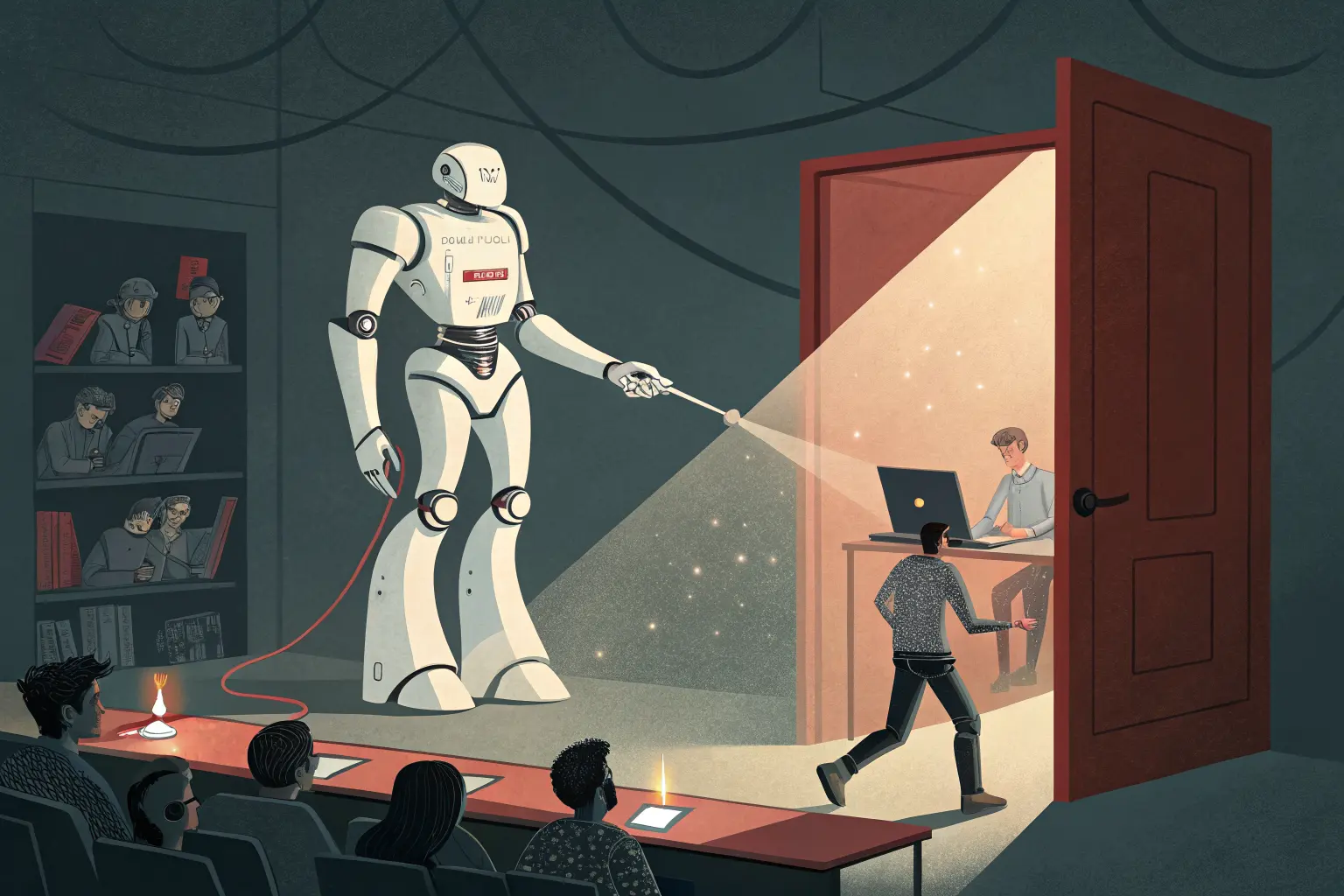
In 1770 a Hungarian inventor named Wolfgang von Kempelen built a chess-playing machine to impress an empress. A wooden Turk in a turban, sitting at a cabinet, beating nobles and, eventually, Napoleon. It was a marvel. It was also a fraud. A human chess master was folded up inside the cabinet the whole time, working the arm with levers and a candle. The machine was a costume for a person.
Amazon named its crowd-labor platform Mechanical Turk. On purpose. They told the joke out loud and nobody laughed, because nobody was listening.
Here is the thing that never makes the pitch deck. A staggering amount of what gets sold as "artificial intelligence" is a person in a cheaper country doing the work while a server takes the credit and the multiple.
Start with Amazon's own "Just Walk Out" stores. You grab a sandwich, you walk out, the AI charges your card. Magic. Except the reporting in 2024 said the magic leaned on something like a thousand workers in India reviewing the camera feeds to figure out what you actually took off the shelf. Amazon disputes the framing and quietly wound the thing down. The autonomous store ran a night shift of humans watching you shop.
Now OpenAI. To make ChatGPT stop spewing the worst of the internet back at you, somebody first had to read the worst of the internet and label it. Time reported in early 2023 that OpenAI used a firm called Sama to hire workers in Kenya, some of them making under two dollars an hour, tagging streams of text about abuse and violence so the model would learn to steer around it. The friendliest chatbot on earth got that way because people in Nairobi absorbed the poison so you would never see it. That is not a footnote. That is the supply chain.
The demo is autonomous. The margins never are.
Then there was Builder.ai. A British startup with an AI named Natasha that would supposedly build your app "as easy as ordering pizza." Microsoft money behind it, a valuation reported north of a billion dollars, the whole robed-wizard routine. It collapsed in 2025, and the reporting says a large share of the "AI" development had been human engineers in India writing the code by hand the entire time. Natasha was a room in Delhi with a deadline.
See the pattern yet. The demo is autonomous. The payroll is not. Every one of these systems has a hidden layer of people, and the business model depends on you never once picturing them.
Why hide it. Because "the AI did it" and "we pay people two dollars an hour to do it" are the same output with wildly different price tags. One earns a forty-times revenue multiple. The other is a call center. Investors buy software margins, not headcount, so the humans get renamed until they sound like infrastructure. They become "data annotators." "Human-in-the-loop reviewers." "Trainers." It is labor wearing a lab coat.
And this is not scaffolding that falls away as the models get smart. The core technique that made modern chatbots usable, reinforcement learning from human feedback, is human feedback by definition. People rank the answers. People write the good demonstrations the model imitates. Every system you think is clever got tutored by an army you will never meet, and the smarter you want it, the bigger the army gets. Scale AI, the company that supplies a lot of that labeling, got so valuable that Meta paid a fortune for a slice of it this year. The picks and shovels of the AI gold rush turned out to be people in headsets.
I am not calling the technology fake. The models are real and genuinely useful, and I use them every day. What is fake is the story wrapped around them. The story where intelligence bloomed out of pure silicon and the humans were just a launch pad we kicked away once the rocket cleared the tower. We did not kick it away. It is holding the whole thing up right now, in shifts, in time zones we schedule around so the product looks seamless during a San Francisco morning.
The tell is that one word, "automated." Every time a company reaches for it, ask the follow-up almost nobody asks. Automated by what. And if the honest answer is "a thousand people you have never bothered to count," then it was never automation. It was arbitrage. You moved the labor somewhere cheap and bolted a logo on the front.
The Turk played Napoleon in 1809. Everyone in that room watched a machine outthink an emperor. Inside the cabinet a sweating man sat cramped over a tiny chessboard by candlelight, doing the actual thinking, getting none of the applause. Two and a half centuries later we rebuilt the same illusion at planetary scale, raised money on it, and called the guy in the box a data annotator.
Pull the curtain on your favorite AI. Count the people. Then decide what you are actually paying for.