The Internet Is Talking to Itself
We automated the writing and the reading on the same day. Now the machines just email each other and we call it output.
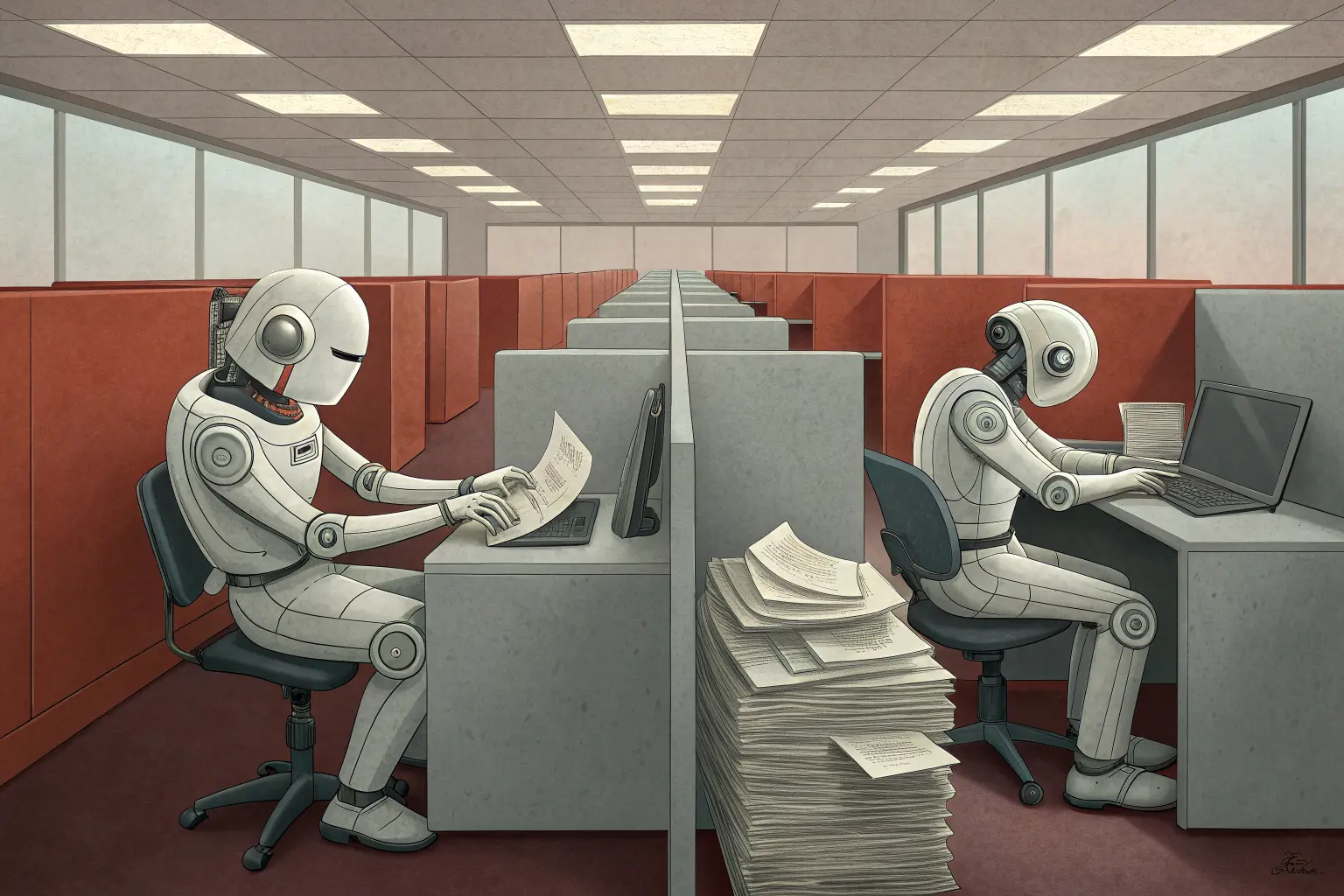
A recruiter opens a job. AI writes the description. A candidate feeds that description to a different AI, which spits out a cover letter and a resume tuned to match. The application lands in an applicant tracking system, where a third model scores it and rejects it before a human ever scrolls past the name. Three models touched that exchange. Nobody read a full sentence. And a dashboard somewhere logged the whole thing as productivity.
That is the part of the AI story that never makes the keynote. We didn't just automate the writing. We automated the reading too, from both ends, on the same afternoon, and what's left in the middle is software performing communication for an audience that quietly got up and left.
Look at your own inbox. Somebody used AI to inflate three bullet points into a five-paragraph email. Your client summarizes it back down to three bullet points with a different AI. The expansion and the compression cancel out perfectly. You have spent tokens, electricity, and a Gemini subscription to arrive back at the three bullets the person started with. The information content of the exchange is zero. The activity looks enormous.
We built a printing press and a shredder and bolted them together, then billed the friction as growth.
Marketing figured this out first, because marketing has no shame. A content team ships forty blog posts a month that no human requested and no human finishes. Who reads them? Google's crawler, which increasingly is a language model, which then regurgitates a blended paraphrase in an AI overview so the human never clicks the post that the machine wrote for the machine to read to summarize for the person who wanted one fact. It's machines all the way down, and the one carbon-based participant gets the worst version of the answer at the very end.
The tell is who this actually serves. Every layer in that stack is a product with a bill attached. The writing model bills the marketer. The reading model bills the reader. The ranking model bills the advertiser. Nobody in the chain is incentivized to notice that the message could have skipped every step and just been the three bullets. The absurdity is the business model. Friction that used to be a cost is now a subscription line item, and both sides pay to generate it.
Defenders will say this is just early. The tools will get better, the loops will tighten, real signal will survive. Maybe. But watch what "better" means in practice. Better means the fake cover letter fools the screener more reliably. Better means the SEO slop ranks higher. Better means the summary of the summary is smoother. None of that closes the loop. It lubricates it. You do not fix a machine talking to itself by making the machine more articulate.
And there's a quieter cost nobody prices in. When you know the recipient is a model, you stop writing for a person. You pad, you keyword-stuff, you optimize for the parser. When you know the sender is a model, you stop reading closely, because why would you grant attention the author didn't spend? Both sides defect at once. The whole point of writing, that a human took time to think so another human could save it, gets hollowed out while the volume goes vertical. We are producing more words than any civilization in history and meaning less by them.
I'm not against the tools. I use them every day, including to draft things you then have to trust I actually thought about. That's the line. The value was never the words. It was the thinking a person did before the words, and the attention a person paid after. Automate the typing all you want. The second you automate both the thinking and the attention, you haven't scaled communication. You've deleted it and kept the invoice.
So here's the test before you fire off another AI-drafted anything. Ask if a human will actually read it. If the honest answer is no, that a bot wrote it for a bot to skim, then you didn't produce work. You produced noise with a receipt. Send the three bullets. Or send nothing. The machines don't need the practice.