You Feel Faster
Everyone swears AI made them quicker. The one study that timed it found the opposite.
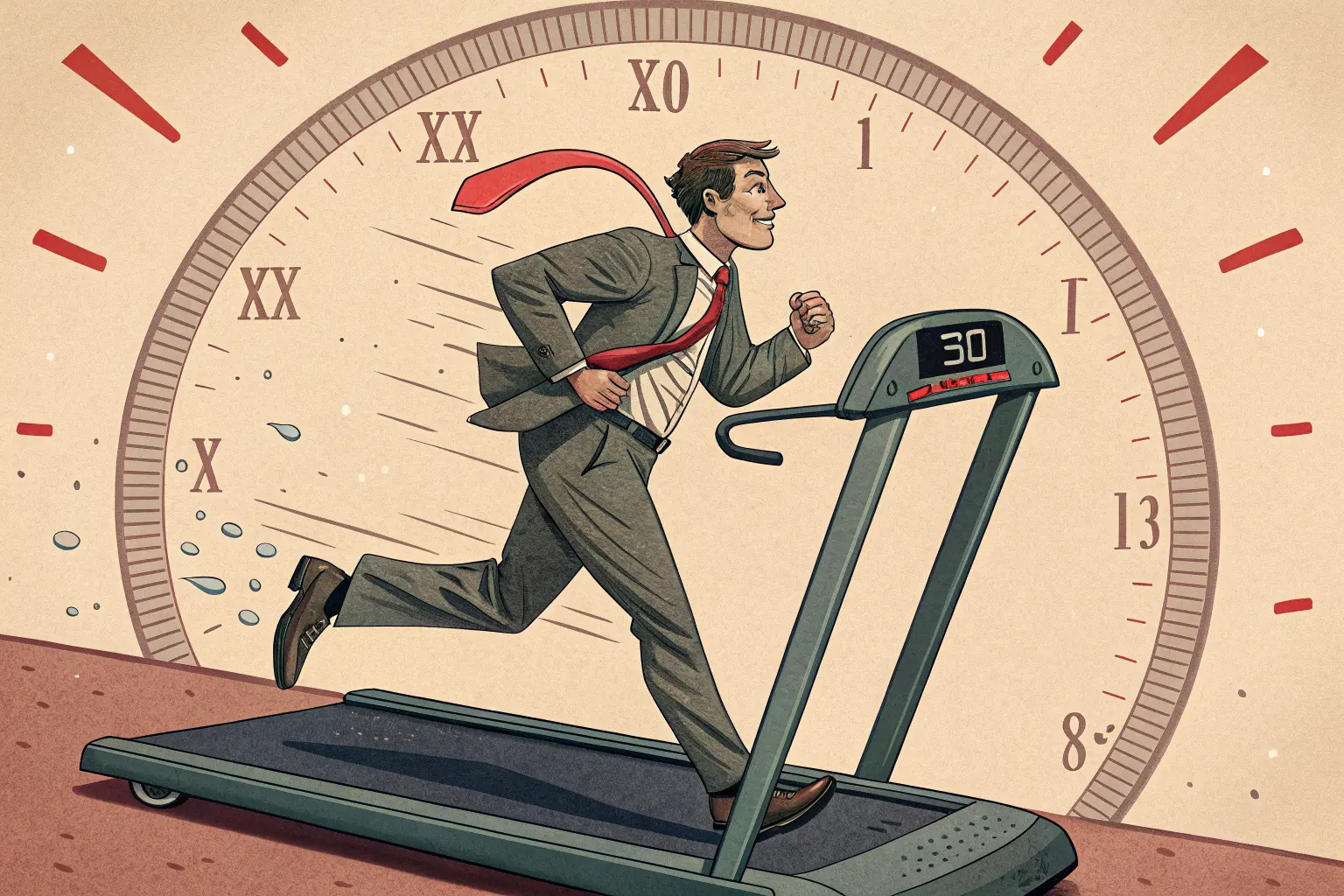
Ask anyone using AI at work whether it makes them faster and they'll say yes. Enthusiastically. Then they'll hand you a number, thirty percent, half again, doubled, and they'll believe it the way you believe your own name. I believe it too, most days. That's exactly why it should scare you. The feeling of being faster and the fact of being faster are two different measurements, and only one of them ever shows up on the invoice.
In 2025 a research outfit called METR did the thing almost nobody bothers to do. They timed it. They took experienced open-source developers, people working in codebases they knew cold, and had them do real tasks with and without AI tools. Before starting, the developers predicted the AI would speed them up by around twenty percent. After finishing, they still believed it had. The stopwatch said they were nineteen percent slower.
Read that again. Slower. Not marginally, not lost in the noise. And the people it happened to walked away convinced of the opposite. That gap, between the felt speedup and the measured slowdown, is close to forty points of pure self-deception, and it's the most honest thing anyone has published about AI at work. Almost nobody repeats it.
The feeling of speed is the product. The speed itself is optional.
Here's why the feeling lies. Waiting is not the same as working, but it weighs less. When you offload the annoying part, the blank page, the boilerplate, the syntax you half-remember, you get a small hit of relief, and your brain files the whole task under "easier." Easier gets remembered as "faster." Meanwhile you're reading code you didn't write, checking it, catching the confident wrong parts, re-prompting, steering. That's real time on the clock. It just doesn't feel like effort, so it never gets counted against the win.
Now take that one developer and scale it to the whole economy. Companies have poured hundreds of billions into this by any estimate. If the productivity were real, you would see it. Output per worker is a number governments track obsessively, and it should be bending upward by now. It isn't, not in any way you can pull cleanly out of the AI. We've been here before. In 1987 the economist Robert Solow looked at the last great automation wave and said you could see the computer age everywhere except in the productivity statistics. Forty years later we built a far more expensive version of the same joke.
The industry has an answer ready, and it's always the same answer. It's early. The gains are coming. Wait for the next model, the next integration, the next workflow. That's the tell. Every technology that actually made people more productive did it fast and did it visibly. The spreadsheet did not need a decade of think-pieces explaining why the productivity was secretly there. You put numbers in, it did the math, the accountant went home early. Nobody had to be talked into believing it. When the results don't arrive and the pitch quietly shifts to "trust the feeling," you're not buying a tool anymore. You're buying a mood.
And the mood sells. This is the part I find genuinely dark. A tool that makes you feel productive without making you productive is, commercially, better than one that just works. The feeling drives the renewal. The seat count climbs because everyone on the team swears by it, and swearing by it costs the vendor nothing to manufacture, because your own brain produces the testimonial for free the moment a small annoyance disappears. You are the factory. They only collect.
Look at where the productivity claims come from and it gets worse. Almost never a stopwatch. They come from surveys. "Most developers report feeling more productive." Feeling. It's sitting right there in the methodology, and everyone quoting the stat sands the word off before it hits the slide. A survey of how fast people feel is a survey of a mood, and we already know the mood was wrong by forty points in the one case somebody checked with a clock. But "feels more productive" becomes "is more productive" by the time it reaches the earnings call, and nobody in that room is paid to catch the swap.
I'm not telling you the tools are useless. I use them every day and I'm not stopping. For some tasks the speedup is real and obvious, and you'll know because you could time it and win. That's the whole test. If you honestly believe AI is making you faster, prove it to yourself the way METR did. Pick a task. Time it both ways. Not the feeling, the clock. Most people never will, and the vendors are counting on precisely that, because the only thing worse for the business than a slow tool is a customer with a stopwatch.
The uncomfortable version of all this: a lot of what we're calling an AI productivity revolution is a very large, very sincere group of people mistaking relief for results. They're not lying. They're just never checking. And a trillion-dollar industry has quietly arranged itself so the question never has to be asked out loud.
You feel faster. Good. Now go find out if you are.